
Single Acoustic Solutions Company vs. Multiple Vendors: What Changes on a UAE Project
Designed for: UAE architects, interior designers, main contractors, MEP engineers, and commercial project managers involved in office, hospitality, education, and healthcare fit-outs.
Executive Summary / Key Takeaway
Bottom Line Answer: Sourcing a single acoustic solutions company consolidates consultancy, product supply, and installation under one single point of accountability. This eliminates multi-vendor blame disputes, maintains strict specification fidelity against acoustic performance standards (such as ISO 3382 sound absorption and ASTM E90 transmission loss), and prevents costly delays or unsealed acoustic junctions during fit-out execution.
An acoustic solutions company delivers consultancy, product supply, and installation as one accountable scope, compared to sourcing an acoustic consultant, a panel supplier, and an installation contractor separately across three unrelated vendors. The practical difference shows up mainly in accountability when something underperforms, and in how smoothly the acoustic scope integrates with the rest of a fit-out programme.
Splitting an acoustic project across multiple vendors isn’t automatically the wrong choice—sometimes procurement rules or existing relationships make it the only realistic option. But it does introduce coordination risk that a single accountable provider removes by default, and that risk is worth understanding before deciding how to structure a project.
This guide covers what changes when a UAE project uses a single acoustic solutions company instead of separate vendors for consultancy, product, and installation, and where each approach tends to work better. It draws on how Opus Building Materials and Opus Acoustic deliver acoustic projects end-to-end, from initial consultancy through product supply and installation.
What “Single Acoustic Solutions Company” Actually Means
A genuine single-provider model covers the full scope under one accountable party: consultancy and target-setting, product selection and supply, installation, and where relevant—post-installation verification. This differs from a company that only badges itself as “full service” but actually subcontracts each stage to a different, uncoordinated third party without owning the outcome across the handoffs.

Where Accountability Changes Between the Two Models
When a specification underperforms—a room still echoes after installation, or a partition fails to achieve its rated sound transmission—the question of why becomes harder to answer across multiple separate vendors.
The consultant can point to the installer’s workmanship. The installer can point to the product specified. The supplier can point to the original consultancy brief. None of them individually owns the gap between what was specified and what was delivered. A single accountable provider removes that ambiguity by design—the same company set the target, chose the product to meet it, and installed it, which means there’s one point of accountability if the result doesn’t match the target.
Where Coordination Matters Most on UAE Fit-Out Projects
Programme Scheduling Across Trades
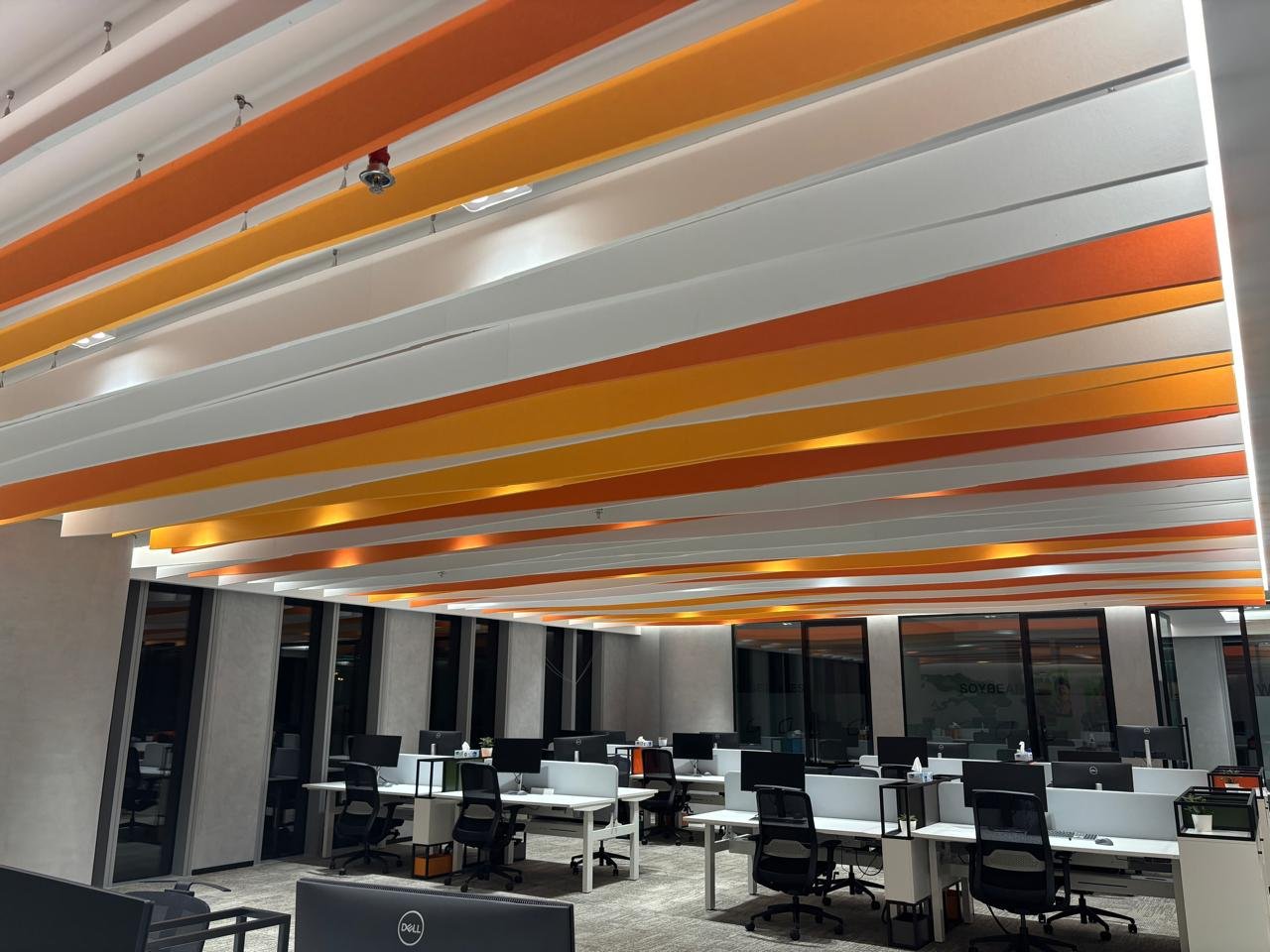
Acoustic installation usually has to sequence around ceiling grid installation, partition work, and MEP trades. A single provider managing consultancy through installation can plan that sequencing directly, rather than each separately contracted party working from their own schedule with limited visibility into the others.
Specification-to-Installation Fidelity
A product specified by a consultant is sometimes substituted or value-engineered by a separate installer or contractor without the original acoustic rationale being preserved. A single provider carrying the specification through to installation has less room for that kind of drift.
Warranty and Post-Handover Support
When a defect appears after handover—an unsealed junction, a product that hasn’t performed as expected—a single provider has clear responsibility for resolving it. Across multiple vendors, resolving the same issue often means establishing which party’s scope the defect actually falls under first.
Multi-Space, Multi-Phase Commercial Projects
Larger commercial fit-outs spanning several space types and construction phases benefit from one provider carrying a consistent acoustic strategy across all of them, rather than potentially different vendors applying inconsistent approaches to different phases of the same building.
When Splitting the Work Across Vendors Can Still Make Sense
A single-provider model isn’t the only valid approach. Procurement policies on some government or large institutional projects require separately tendered packages regardless of coordination trade-offs. An existing relationship with a trusted installer that a client wants to retain is also a legitimate reason to keep installation separate from consultancy. In both cases, the coordination risk described above doesn’t disappear, but it can be actively managed with clear scope boundaries and a named point of coordination between vendors.
How to Evaluate a Single Acoustic Solutions Company, Step by Step
1. Confirm the Scope Genuinely Spans Consultancy Through Installation
Ask specifically whether target-setting, product specification, and installation sit under the same accountable team, not just under the same company name with subcontracted stages.
2. Check How Specification Changes Are Handled Internally
A single provider should be able to explain how a product substitution mid-project is evaluated against the original acoustic target, since that check is easy to skip when everything happens in-house without an external second party questioning it.
3. Ask About Warranty Scope Specifically
Confirm whether warranty covers the installed system’s acoustic performance, not just material defects—a panel that’s structurally fine but installed with an unsealed junction can still fail its acoustic purpose under ISO 3382 room acoustic testing standards.
4. Review Past Multi-Phase or Multi-Space Project Experience
For larger commercial projects, ask for examples of coordinating acoustic scope across multiple space types or construction phases within a single building.
5. Clarify Post-Handover Support
Establish what happens if a completed space underperforms after handover—whether re-measurement, adjustment, or further treatment falls within the original scope or becomes a new commercial discussion.
What Gets Missed When Vendor Coordination Isn’t Someone’s Explicit Job
- A product substituted late in a project for cost or availability reasons, without anyone re-checking it against the original acoustic target or UAE Civil Defense Fire and Life Safety Code requirements.
- Installation completed on schedule but out of sequence with a ceiling or partition trade, compromising a junction detail the specification depended on.
- A defect identified after handover that takes weeks to resolve simply because responsibility between vendors isn’t clearly established.
- Inconsistent acoustic treatment across different phases of a multi-phase project, because no single party carried the strategy across all of them.
Single Provider vs. Multiple Vendors, at a Glance
| Factor | Single Acoustic Solutions Company | Multiple Separate Vendors |
|---|---|---|
| Accountability if performance falls short | One party, directly responsible | Split across vendors, often disputed |
| Specification-to-installation fidelity | Carried through by the same team | Vulnerable to substitution or drift |
| Scheduling coordination | Managed internally by one provider | Dependent on each vendor’s own schedule |
| Warranty and defect resolution | Clear, single point of contact | Requires establishing which vendor’s scope applies |
| Best suited to | Most commercial and hospitality projects | Projects under specific procurement or tendering rules |
How Opus Building Materials and Opus Acoustic Deliver as a Single Provider
Opus Building Materials and Opus Acoustic operate as one accountable provider across consultancy, product, and installation on UAE projects, carrying the same acoustic target from initial assessment through to completed installation. For a closer look at how that target is built into a coordinated specification across a space’s different surfaces, see our guide on what an acoustic system is and why coordinated specification matters.
The gap between a good specification and a good outcome is installation and coordination. Keeping that gap inside one accountable scope is what a single-provider model is actually for.
Frequently Asked Questions
Direct Answer: Not necessarily. While a bundled scope can appear higher on a single quote, it often avoids costs associated with rework, delay, or unresolved defects that can arise from uncoordinated multi-vendor delivery.
Direct Answer: Yes, this is a common hybrid approach. It requires clear scope boundaries and a specification detailed enough that the installer can execute it faithfully without the original consultant present throughout.
Direct Answer: Ask directly whether the same team is accountable for consultancy, specification, and installation outcomes, or whether each stage is separately subcontracted without a shared accountability structure.
Direct Answer: Yes, and it’s arguably simpler to justify at small scale, since the coordination overhead of managing multiple vendors is disproportionate to a single-room scope.
Direct Answer: Clearly defined scope boundaries between vendors, a named coordination point of contact, and a shared reference to the original acoustic target that any specification changes must be checked against.
Direct Answer: Opus Building Materials and Opus Acoustic can operate as a single accountable provider or support a defined scope within a larger multi-vendor project, depending on the client’s procurement requirements.
Consultancy, product, and installation under one accountable scope.
Coverage: Dubai, Abu Dhabi, Sharjah & all UAE Emirates
Phone: +971 50 826 5672