
Acoustic Noise Survey Services in Dubai, UAE
Calibrated acoustic noise measurement, environmental monitoring, and mapping solutions for regulatory compliance in Dubai & the UAE.
Book a Noise SurveyA noise survey is the quantitative measurement of existing sound levels, sources, and acoustic patterns at a site using calibrated Class 1 instruments rather than a walk-through impression to establish whether a space complies with a noise limit, or to build an evidence base before design or legal action. It differs from a general acoustic inspection in that its output is an actionable dataset: logged decibel readings, frequency breakdowns, and often a visual noise map, not just a treatment recommendation.
Key Takeaways & Direct Answer Summary
- Definition: A noise survey measures sound levels, frequency, and duration to provide verifiable empirical decibel data.
- Target Audience & Use Cases: Designed specifically for MEP consultants, commercial developers, main contractors, industrial plant engineers, and legal entities operating across Dubai, Abu Dhabi, and Sharjah.
- When Needed: Required for municipal compliance submissions, resolving tenant-to-tenant disputes, managing industrial/construction noise limits, and pre-fit-out due diligence.
- Standards: Measured in A-weighted decibels dB(A) and 1/1 octave band frequencies against UAE environmental noise limits.
If you’ve been told a space is “too noisy” without anyone measuring exactly how noisy, how loud, at what frequency, or for how long, that’s an opinion not a survey. A proper noise survey turns a complaint into a number, and a number is what compliance authorities, landlords, and contractors actually act on.
This guide covers what a noise survey involves, how it differs from noise mapping and long-term environmental monitoring, and when a UAE project needs one. It draws on the noise survey, mapping, and monitoring services run by Opus Acoustic under its site inspection division, operating in accordance with environmental limits set by the UAE Ministry of Climate Change and Environment (MOCCAE).
Noise Survey vs. Noise Mapping vs. Environmental Monitoring
Direct Answer: While often used interchangeably, these three solutions serve distinctly different technical purposes:
- Noise survey: A point-in-time measurement of ambient noise levels, background sound, structure-borne vibration, and problem frequencies at a specific location.
- Noise mapping: Visual data modelling that shows how sound pressure propagates across a layout, identifying weak nodes and high-exposure zones across an entire floor plan or site.
- Environmental noise monitoring: Long-term, continuous acoustic telemetry that tracks sound thresholds over extended periods, used to demonstrate ongoing compliance rather than a single snapshot.
A project might need one of these, or all three in sequence — a survey to establish the baseline, mapping to visualise where the problem concentrates, and monitoring to prove it stays resolved.
The Standard a Noise Survey Is Measured Against
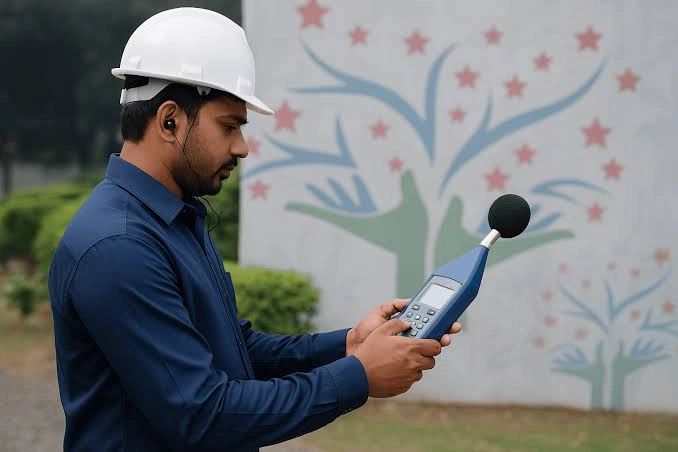
A credible noise survey reports results against a recognised reference, not just a raw dB figure. Sound pressure levels are typically logged in dB(A) – the A-weighted scale that reflects how the human ear perceives loudness – and compared against applicable limits such as workplace exposure thresholds or municipal environmental noise regulations. Where vibration or low-frequency content is a concern, octave-band frequency analysis is used rather than a single overall number, since two spaces can share the same dB(A) reading while one has a genuinely disruptive low-frequency hum the other doesn’t.
UAE-Specific Reasons a Noise Survey Gets Commissioned
In the UAE region, noise surveys in Dubai, Abu Dhabi, and Sharjah tend to get triggered by four core project requirements:
Construction and Industrial Noise
Ongoing construction adjacent to occupied buildings is a near-constant feature of UAE development. A noise survey establishes whether noise from a neighbouring site actually exceeds permitted limits, providing evidence needed to raise or defend a formal complaint.
Mixed-Use Building Disputes
Retail, F&B, and residential units sharing a single structure regularly generate noise disputes between tenants. A survey provides an objective measurement of sound transfer through party walls or floors, rather than relying on conflicting accounts.
Regulatory & Sustainability Compliance
UAE environmental and workplace safety guidelines set defined noise exposure limits for certain occupancies and industrial settings. A documented survey is what demonstrates compliance to a regulator or certifying body.
Pre-Acquisition & Fit-Out Due Diligence
Before leasing or fitting out a commercial unit, a noise survey flags whether the shell’s ambient noise profile — from HVAC, adjoining units, or external traffic — will create a problem before design work begins.
How a Noise Survey Is Carried Out, Step by Step
A professional acoustic survey follows six standardized execution steps:
1. Scope and Objective Confirmation
The purpose of the survey is defined first — a one-off compliance check, a dispute-resolution measurement, or the baseline stage of a larger acoustic project — since this determines what equipment and duration are needed.
2. Calibrated On-Site Measurement
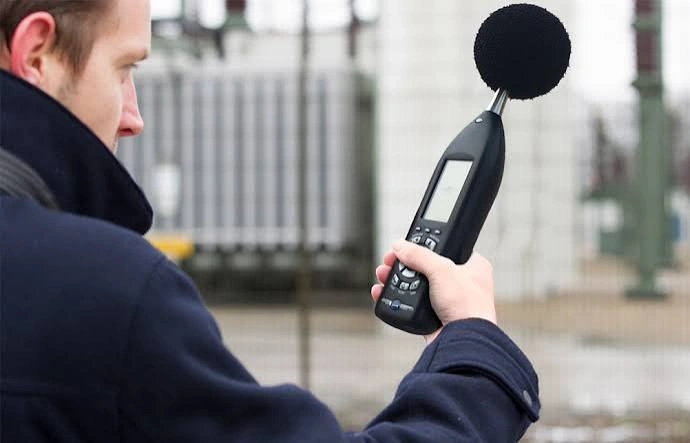
Sound level meters are positioned at representative points and calibrated before logging begins, capturing ambient noise levels, background sound, and structure-borne vibration across relevant times of day.
3. Frequency and Source Analysis
Readings are broken down by frequency band and, where possible, attributed to source — HVAC, traffic, adjoining occupancy, or industrial plant — since the fix for each is different even at an identical dB(A) reading.
4. Noise Mapping (Where Required)
For larger sites, measurements across multiple points are compiled into a visual noise map, showing sound pressure propagation across the layout and highlighting the zones driving the overall reading.
5. Reporting Against Applicable Limits
Findings are compared against the relevant workplace, environmental, or contractual noise limit, with a clear statement of compliance or exceedance — not just raw numbers without context.
6. Recommendation or Monitoring Handover
Where the survey identifies an ongoing risk rather than a resolved snapshot, it can transition into environmental noise monitoring — continuous telemetry over weeks or months to track whether levels stay within threshold.
What a Proper Noise Survey Catches That an Informal Check Misses
Direct Answer: Objective testing using calibrated equipment identifies technical sound transmission metrics that qualitative checks miss:
- A source wrongly assumed to be the main contributor, when frequency analysis shows a different piece of plant is driving most of the exceedance.
- Noise that only breaches limits at specific times of day, which a single daytime walk-through would never catch.
- Structure-borne vibration being logged as airborne noise, leading to a treatment recommendation that wouldn’t have worked.
- A site that measures compliant at one point but has a distinct hotspot elsewhere on the floor plan, invisible without mapping.

Where Noise Surveys Are Most Commonly Needed
The following comparison table outlines primary project scenarios and their respective analytical deliverables:
| Situation | What the Survey Establishes |
|---|---|
| Construction noise complaints | Whether neighbouring site noise exceeds permitted daytime/night-time limits |
| Tenant-to-tenant disputes | Objective sound transfer data through shared walls or floors |
| Industrial and plant facilities | Occupational noise exposure levels against UAE workplace safety limits |
| Pre-lease due diligence | Baseline ambient noise profile of a shell space before fit-out |
| Hospitality and F&B venues | Late-night noise levels against nearby residential exposure limits |
| Regulatory compliance projects | Documented evidence for submission to environmental or municipal authorities |
How Opus Acoustic Runs Noise Surveys, Mapping, and Monitoring
This is the same site inspection methodology Opus Acoustic applies across its on-site noise survey, advanced noise mapping, and environmental noise monitoring services: calibrated measurement first, source and frequency analysis second, and a documented report before any treatment or compliance recommendation is made. During a recent commercial retrofit in Business Bay, Dubai, our Class 1 meters identified a 63 Hz low-frequency vibration spike originating from an unisolated chiller on an adjacent roof, preventing $45,000 in unnecessary internal acoustic wall lining.
A noise survey costs a fraction of what an unresolved noise dispute or a failed compliance inspection costs. That data is the difference between a defensible position and a guess.
Frequently Asked Questions
A noise survey focuses specifically on measuring existing sound levels and sources. An acoustic site inspection is broader — it also assesses room geometry, surface materials, and reverberation time to inform a treatment specification. A project can need one or both.
A single point-in-time survey is often completed within a day. Noise mapping across a larger site takes longer depending on the number of measurement points, and environmental monitoring runs continuously over the agreed period typically weeks to months.
A properly calibrated survey with logged data and a clear methodology is generally the kind of evidence regulators and mediators expect, though acceptance depends on the specific authority or process involved.
A standard survey is usually sufficient for a single room or a specific complaint. Mapping is worth the extra scope when noise exposure varies significantly across a larger floor plan or site and you need to see where it concentrates.
Ongoing compliance requirements, ongoing construction nearby, or a dispute where noise levels vary significantly over time all favour continuous monitoring over a single snapshot.
Yes. Every survey, mapping exercise, or monitoring period concludes with a documented report of measurements against the applicable limit.
Book a Noise Survey Today
Get calibrated, evidence-based noise data before you dispute, comply, or commit to treatment.
Phone: +971 50 826 5672 | Coverage: Dubai, Abu Dhabi, Sharjah & all UAE Emirates