
What Is Noise Mapping and When Do You Need It in the UAE?
Key Takeaway / Quick Summary
Direct Answer: Noise mapping visualizes spatial sound distribution across an entire facility or construction perimeter, unlike single-point surveys that only measure localized spots. It is ideal for UAE shopping malls, corporate campuses, logistics hubs, and construction zones facing municipal environmental compliance checks.
Noise mapping is the process of converting sound level measurements taken at multiple points across a site into a visual model that shows how noise pressure varies across an entire layout — a floor plate, a campus, or a construction perimeter — rather than reporting a single reading for one location. It’s used where noise exposure isn’t uniform and a single-point survey wouldn’t show the full picture.
A single noise reading tells you the level at one spot, at one moment. It doesn’t tell you whether the food court is fine but the loading dock isn’t, or whether a construction site is compliant at the site boundary closest to the road but not at the boundary closest to a residential tower. Mapping exists specifically to answer that kind of question.
This guide covers what noise mapping involves, how it differs from a standard point-in-time noise survey, and the UAE project types where mapping earns its extra scope. It draws on the advanced noise mapping service Opus Acoustic runs as part of its site inspection division, the specialist acoustic arm of Opus Building Materials.
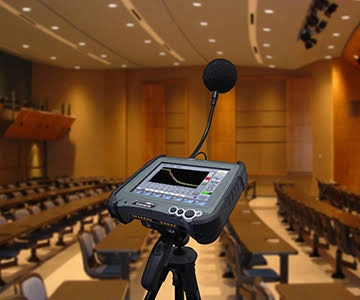
Noise Mapping vs. a Standard Noise Survey
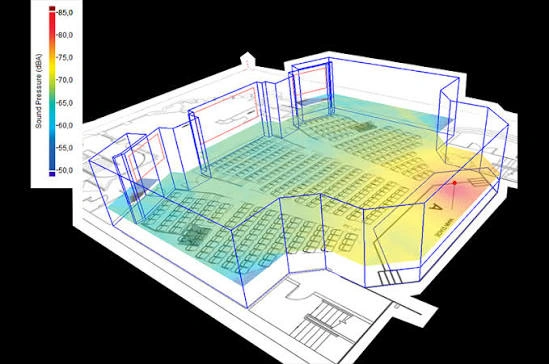
A standard noise survey measures at one or a small number of representative points and reports a result for that location. Noise mapping measures across many points — or uses modelling software to interpolate between measured points — and produces a visual output, typically a colour-graded plan showing where noise pressure is highest and lowest across the full area.
That difference is significant because a survey and mapping serve distinct purposes. A survey answers “is this room too loud?” Mapping answers “where across this entire site does the noise problem actually concentrate, and how far does it extend?” A single boardroom rarely needs mapping. A shopping mall, a business park, or a construction-affected residential block usually does. For single-point checks, see our guide on noise survey services UAE.
How Noise Mapping Data Is Produced
Mapping output is only as reliable as the measurement and modelling method behind it. Sound pressure levels are logged in dB(A) at each measurement point using calibrated equipment, consistent with the same standard used in a point-in-time survey.
Where physical measurement across every point on a large site isn’t practical, propagation modelling software is used to interpolate noise levels between measured points, accounting for distance, barriers, and reflective surfaces — the same principles behind ISO 9613 outdoor sound propagation standards. The result is a plan-view or elevation map with noise levels represented as colour-graded contours, similar in concept to a weather pressure map.
UAE Project Types Where Noise Mapping Is Worth the Scope
Mapping earns its additional cost and time on sites where noise exposure genuinely varies across the layout, which in the UAE tends to mean:
Shopping Malls and Mixed-Use Retail
Food courts, cinemas, atria, and retail corridors all have different acoustic profiles, and noise from one zone frequently bleeds into an adjoining one through open voids or shared HVAC returns. Mapping shows exactly where that bleed concentrates.
Business Parks and Corporate Campuses
Multiple buildings, outdoor break areas, and car parks across a single site can each have different ambient noise exposure. Mapping across the whole campus identifies which zones fall outside comfortable outdoor noise levels.
Construction-Affected Residential Areas
Where a construction site sits adjacent to occupied residential towers, mapping across multiple boundary points shows whether every affected façade is within permitted limits — not just the boundary nearest the site office where a single measurement is often taken.
Industrial and Logistics Facilities
Warehouses, loading docks, and plant rooms generate noise that varies significantly by zone. Mapping across a facility identifies which areas require hearing protection under UAE workplace safety limits and which don’t.
How a Noise Mapping Engagement Runs, Step by Step
1. Site and Scope Definition
The area to be mapped is defined — a single floor, an outdoor perimeter, or an entire multi-building site — along with the reason for mapping, since this determines point density and required accuracy.
2. Measurement Point Planning
Measurement locations are planned across the site to capture representative coverage, concentrating points around known or suspected noise sources and sensitive receptors such as residential façades.
3. Calibrated Field Measurement
Sound level readings are logged at each planned point, with equipment calibrated before and checked during the survey to ensure consistency across a potentially large number of readings taken over time.
4. Propagation Modelling
Where full point-by-point coverage isn’t practical, software models noise propagation across the site using the measured points as calibration data, accounting for distance, barriers, and terrain or building geometry.
5. Map Generation
Results are compiled into a visual noise map — typically colour-graded contours overlaid on the site plan — showing exactly where noise levels are highest and where they fall within acceptable limits.
6. Reporting and Recommendation
The map is delivered alongside a written report identifying zones of concern, the applicable limit each zone is measured against, and, where relevant, treatment or mitigation recommendations for the areas driving the exceedance.

What Noise Mapping Catches That a Single-Point Survey Misses
- A site that measures compliant at its main entrance but has a distinct hotspot near a rear loading area, invisible without coverage across the full perimeter
- Noise exposure that varies significantly between adjacent zones sharing the same building — retail below, offices above — where a single reading can’t represent both
- The true extent of a construction noise impact zone, rather than just a pass/fail reading at one boundary point
- Cumulative noise from multiple simultaneous sources across a site, which individual point readings can understate when taken separately
Where Noise Mapping Is Most Commonly Commissioned in the UAE
| Site Type | What the Map Typically Reveals |
|---|---|
| Shopping malls & mixed-use retail | Noise bleed between adjacent zones through voids or shared HVAC |
| Business parks & campuses | Outdoor break areas or car parks exceeding comfortable ambient levels |
| Construction-affected residential blocks | Uneven noise impact across different building façades |
| Industrial & logistics facilities | Zones requiring hearing protection under UAE workplace safety limits |
| Large hospitality developments | Pool decks, event lawns, or terraces affected by adjacent service areas |
| Environmental compliance projects | Site-wide evidence for submission to municipal or environmental authorities |
How Opus Acoustic Delivers Noise Mapping
This is the same site inspection methodology Opus Acoustic applies across its on-site noise survey, advanced noise mapping, and environmental noise monitoring services: calibrated field measurement, standards-based modelling, and a documented visual report before any treatment or compliance recommendation is made. For a single room or a straightforward compliance check, a standard point-in-time survey is usually sufficient — see our guide on what a noise survey involves and when you need one if that’s a closer match to your situation.
Frequently Asked Questions
A survey measures at one or a few points and reports a result for that location. Mapping measures or models across an entire site and produces a visual output showing how noise levels vary across the whole area.
A standard survey is enough for most single-room or single-complaint situations. Mapping is worth the added scope for larger sites — malls, campuses, construction-affected zones — where noise exposure genuinely varies across the layout.
This depends heavily on site size and point density. A single-floor retail unit can be mapped in a day or two; a multi-building campus or a large construction perimeter takes longer.
Yes. A documented map with logged measurement points and modelling methodology is the kind of evidence typically expected for site-wide environmental or municipal compliance submissions.
Both. Indoor mapping typically covers a building floor plate or multiple zones within a structure; outdoor mapping covers site perimeters, campuses, or construction-affected areas using propagation modelling.
The report includes recommendations for the zones driving any exceedance — this can lead into a more detailed site inspection or treatment specification for the affected area specifically, rather than the whole site.
Book a Noise Mapping Assessment
See exactly where noise concentrates across your site before you commit to treatment or compliance action.